Software Supply Chain Attacks: The Door Most Firms Leave Open
Nov 1, 2026 · @Abdul Rahim
Software flaws now rank above stolen credentials as a main way into organisations, and third-party links appear in 48% of breaches, according to Verizon’s 2026 data as reported by Analytics Insight.
Why attackers love the supply chain
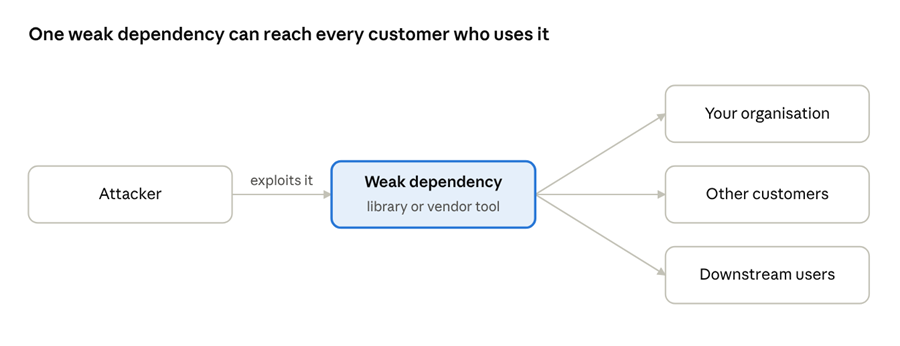
You can harden your own systems and still be breached through someone else’s. Every library, plugin, vendor tool and cloud service you depend on is a door an attacker can try, and one compromised component can open the door to thousands of customers at once.
Two trends make this worse in 2027:
- Speed. Automated reconnaissance and AI-assisted coding could shrink the time between a public vulnerability disclosure and widespread exploitation attempts. The gap defenders used to rely on for patching is closing.
- Sprawl. Modern software is assembled from many dependencies, so most organisations cannot say exactly what they run, or who maintains it.
The attack path
[embedded content: supply chain attack path · 1 weak link, 3 groups of victims]
An attacker who gets into one widely used component does not need to attack each customer separately: the trusted update carries the problem to everyone who depends on it.
What to do about it
You cannot eliminate supply chain risk, but you can make it visible and survivable.
- Keep an inventory of software dependencies. List what you run, where it came from and who maintains it.
- Define a fallback plan for business-critical providers. Decide in advance what happens if a key vendor or service goes down or is compromised.
- Remove what no longer needs to be online. Retire forgotten servers, test environments and unused tools rather than hoping nobody finds them.
- Patch faster. Treat actively exploited vulnerabilities as urgent, because the window between disclosure and attack is shrinking.
- Ask your vendors hard questions. Check how they secure their own builds, and what they will tell you if they are breached.